Why Your Strokes Gained Total May Not Equal the Sum of Categories
You add up off the tee, approach, around the green, and putting — and the number does not quite match the total. It is not a bug. Here is what is really going on under the hood.

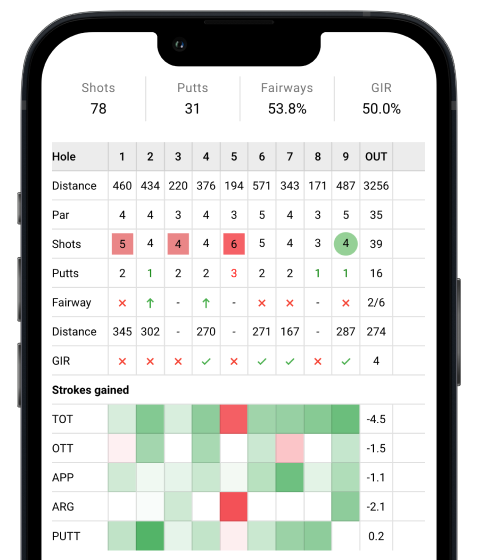
Open your round summary in golfity, look at the four strokes gained category cards, and add them in your head. Off the tee plus approach plus around the green plus putting. Then look at the total at the top of the screen.
Most of the time, it lines up. Sometimes it doesn’t — by a tenth, by two-tenths, occasionally by more. The total reads -4.3. The sum of the four cards is -4.4. Or you total +1.2 but the cards add to +1.1.
This is the single most common “is this a bug?” question we get. It is not a bug. It is the unavoidable result of how strokes gained is computed under the hood, combined with how numbers get rounded for display. This post walks through every reason that gap can exist, when you should ignore it, and the much rarer cases where it is signalling a real data problem worth fixing.
The Quick Answer
Three things explain almost every mismatch between your strokes gained total and the sum of categories:
- Display rounding. Internal numbers are calculated to many decimal places. The screen shows one. Add four rounded numbers and you can easily be off by a tenth from a separately rounded total.
- Penalty strokes. A water ball or out-of-bounds penalty is a stroke lost. It belongs in the total, but it does not belong to any of the four shot categories.
- Edge-case shots. Provisional balls, balls dropped under rule relief, and shots from positions that don’t cleanly belong to one category can shift how a hole’s strokes gained is split versus summed.
If you are off by 0.1 or 0.2 strokes per round, it is rounding. If you are off by more than that, it is probably category 2 or 3. The math is fine. The total is the trustworthy number.
How Strokes Gained Is Actually Calculated
To understand the mismatch, you have to understand the calculation. The strokes gained calculator does this for individual shots, but the same engine runs over every shot in your round.
For each shot, strokes gained is:
SG = expected_strokes(start_position) - expected_strokes(end_position) - 1
If you ended in the hole, expected_strokes(end_position) is zero. The “-1” accounts for the shot you actually played.
Two things flow from this:
- Every individual shot has a strokes gained value, computed from a lookup table of expected strokes by lie and distance. Mark Broadie’s Every Shot Counts established this framework; we cover the underlying math in example of strokes gained calculation and strokes gained for individual shots.
- Each shot is assigned to one of four categories based on where it was played from: off the tee, approach, around the green, or putting. That category breakdown is covered in detail in the complete guide to strokes gained categories.
The category total is just the sum of every shot’s strokes gained value within that category, across the round. The round total is the sum of every shot’s strokes gained value, full stop. In a clean dataset, the two are identical by definition. The category total and the sum of shots are the same operation, just sliced differently.
So when they differ, something is happening between the raw math and what you see on screen. Let’s walk through each cause.
Reason 1: Display Rounding (The Most Common)
Every strokes gained value lives internally as a high-precision floating-point number. A 6-iron from 168 yards in the fairway to 18 feet might be worth +0.0743 strokes. Two shots later, a 14-foot putt that misses is worth -0.3917. Real numbers, eight decimals deep.
When the app displays a category card, it rounds. You see -1.4, not -1.4218. When it displays the total, it rounds. You see -4.3, not -4.3157.
Here is the trap: the total is computed from the unrounded per-shot values, then rounded once at the end. The four category cards each round independently. Add four independently-rounded values and you can be off from the rounded total.
A worked example. Suppose your true values are:
| Category | True value | Displayed (rounded to 0.1) |
|---|---|---|
| Off the Tee | -0.74 | -0.7 |
| Approach | -2.31 | -2.3 |
| Around the Green | -0.46 | -0.5 |
| Putting | -0.49 | -0.5 |
| Total | -4.00 | -4.0 |
Sum the displayed values: -0.7 + -2.3 + -0.5 + -0.5 = -4.0. That one ties out.
Now nudge one category slightly:
| Category | True value | Displayed |
|---|---|---|
| Off the Tee | -0.74 | -0.7 |
| Approach | -2.32 | -2.3 |
| Around the Green | -0.42 | -0.4 |
| Putting | -0.52 | -0.5 |
| Total | -4.00 | -4.0 |
Sum the displayed values: -0.7 + -2.3 + -0.4 + -0.5 = -3.9. The displayed total is -4.0, but the sum of the cards is -3.9. A 0.1 mismatch, from rounding alone, with no error anywhere in the data.
This is the same effect that makes a restaurant bill of $9.99 + $9.99 + $9.99 round to $30 even though three nines technically add to $29.97. Independent rounding at the line-item level doesn’t have to match a rounded grand total.
Statistically, four independent values each rounded to the nearest 0.1 will produce a mismatch with the rounded sum about half the time. That is just the math of rounding, not a sign that anything is wrong.
Reason 2: Penalty Strokes
A penalty stroke is a stroke counted against your score that you didn’t actually hit a shot for. Water hazards, out-of-bounds, unplayable lies, lost balls — all add one or two strokes to your hole score without producing a swing that gets analyzed.
This is the cleanest reason for a real, non-rounding gap. The total reflects your score against par (and therefore against expected strokes for the round). The four categories reflect the strokes gained from each shot you played. A penalty is in the first calculation but not the second.
Consider a par 4 where you hit driver into the water, drop, hit your third on the green, two-putt for a double bogey 6.
- Score: 6 (par 4 + 2)
- Shots played: 3 (drive, approach, two putts split as one putt + one putt)
- Strokes gained from shots played: maybe -0.4 across the categories
- Strokes gained for the hole as a whole: roughly -2.0 (you doubled the hole)
Where does the missing 1.6 strokes go? It is the penalty. Different strokes gained implementations handle this in different ways:
- Total absorbs the penalty; categories don’t. The round total shows the full -2.0 hit, but the category cards only show the -0.4 from your actual shots. The sum of categories will be 1.6 strokes less negative than the total. This is the most common approach and the one most aligned with Mark Broadie’s original framework.
- Penalty is allocated to the category of the offending shot. The drive into the water gets charged the full penalty. Off the tee shows -2.0 instead of -0.4. The sum ties out to the total, but driving looks worse than the actual swing was.
- Penalty is split or socialized. Some implementations spread the cost. This is the rarest and we generally avoid it because it obscures which category actually leaked.
golfity uses approach 1 for category cards on most views: each category reflects the quality of the shots in that category, and penalty strokes show up at the round total. That keeps the per-shot numbers honest and matches how PGA Tour ShotLink data is presented. The trade-off is exactly the gap you’re investigating: rounds with penalty strokes will have a category sum that comes out less negative than the round total.
If you played a clean round with no penalties, this source of mismatch goes to zero. If you took two penalty strokes in the round, expect roughly 2 strokes of gap, in addition to any rounding.
Reason 3: Edge-Case Shots and Reclassifications
The four-category model is clean in concept and fuzzy at the edges. A few shot types can produce small mismatches:
Provisional balls. When you hit a provisional that turns out to have been needed, the provisional becomes your next shot. If a shot is logged and later corrected, the category sums may briefly drift from the round total until the data is reconciled.
Drops under relief. Free relief (cart path, embedded ball) doesn’t add a stroke but changes your start position. Penalty drops (lateral hazard, unplayable) add a stroke. Misclassifying which one happened can shift a hole’s totals by a stroke.
Boundary shots between categories. Most systems use 30 yards as the boundary between approach and around the green (the standard following understanding strokes gained around the green and PGA Tour conventions). The expected strokes value is the same either way, but if you re-categorize a shot, one category moves up and another moves down by exactly that amount. The total does not change.
Shots not assigned a category. A whiff that the player elected not to log, or a shot excluded from analysis, produces a hole score that reflects the stroke but no category contribution. Rare, but possible after manual hole edits.
None of these are bugs, but each can move the category sum away from the total. The total is computed from the score; the categories are computed from the shots. When the two disagree, the score-derived total is generally the trustworthy number.
Reason 4: Tee-to-Green and Per-Hole Aggregation
A subtler version of the question comes up when people compare the “tee-to-green” number to its underlying categories. Tee-to-green strokes gained is off the tee + approach + around the green. At full precision it ties to those three categories exactly; with one-decimal display, it can again be off by 0.1 — same rounding issue.
There is also a quieter mechanical reason. golfity can compute round totals two ways: bottom-up by summing every shot’s strokes gained, or top-down by computing each hole as expected_strokes(tee) - score and summing across holes. In clean data the two are identical. The top-down method picks up penalty strokes automatically (they are in the score), while the bottom-up method only does so if penalties are recorded as shots in the right category. The round total at the top of the screen is generally top-down; the category cards are bottom-up. That gap, when present, is exactly your unallocated penalty strokes.
When the Gap Is Telling You Something Real
Almost all the mismatches you will ever see are 0.1-0.3 strokes per round and explained by rounding, with a small extra contribution from any penalty strokes you took. That is signal-free noise — ignore it.
A gap of more than ~0.5 strokes per round, with no penalty strokes recorded, is worth a look. It usually means one of:
- A shot was logged but not assigned a category (very rare, but possible after manual edits).
- A hole was edited and the recalculation is partial. Re-saving the round usually fixes this.
- A penalty stroke was added to the score but not flagged as a penalty internally, so it doesn’t get reflected anywhere in the category breakdown. This is the only case worth reporting, because it usually means a tap-in or drop didn’t get categorized correctly.
If you ever see a gap that big, scroll through the hole-by-hole strokes gained view. The bad hole will stand out: one hole where the per-hole total doesn’t match the sum of its shots. Fix that hole and the round-level numbers reconcile.
A Real Round, Annotated
Here’s a round from a 14-handicap, with rounding and a penalty stroke included, so you can see how the numbers really layer up.
| Hole | Score | Par | Holes’ SG | OTT | APP | ARG | Putt |
|---|---|---|---|---|---|---|---|
| 1 | 5 | 4 | -1.0 | -0.2 | -0.4 | -0.3 | -0.1 |
| 2 | 6 | 4 | -2.0 (*) | -1.0 | -0.4 | -0.1 | -0.5 |
| 3 | 4 | 4 | 0.0 | 0.1 | -0.2 | 0.0 | 0.1 |
| … | |||||||
| Total | 88 | 72 | -5.2 | -1.4 | -1.8 | -0.5 | -0.5 |
(*) Hole 2 included a one-stroke penalty for a lateral hazard drop.
Add the four category totals: -1.4 + -1.8 + -0.5 + -0.5 = -4.2. The round total reads -5.2.
The 1.0-stroke gap is the penalty on hole 2 — the score absorbs it, the category cards don’t. Add a hypothetical extra 0.1 of rounding noise and you have a textbook example of the mismatch.
If you removed the penalty from your scorecard, the round would have been 87 (one stroke better), and the round total would tie out to -4.2, matching the category sum.
What Most Golfers Should Do
In the order they matter:
- Trust the round total. It ties to your score and reflects the full impact of the round, including penalties.
- Use the category cards for diagnosis. Their relative sizes — which category is doing the most damage — are what matter, not their precise sum. The lessons in how to read your strokes gained numbers all work off relative category sizes.
- Ignore gaps under 0.3 strokes. That is rounding plus maybe a small penalty contribution. There is nothing to fix.
- Investigate gaps over 0.5 strokes if no penalties were recorded. Open the round and look hole-by-hole for one outlier. Usually the fix is a one-tap correction.
If you ever want to confirm a specific shot’s contribution, drop the start and end positions into the strokes gained calculator and check it by hand. That bypasses every rounding and aggregation question and gives you the unvarnished number for one shot.
Putting It Together
A strokes gained total and the sum of its categories disagreeing by a tenth or two is not a flaw in the data. It is the natural shadow of three honest things layered on top of each other:
- Categories that hold their own per-shot strokes gained, rounded for display.
- A round total that holds your score against expected strokes, rounded for display.
- Penalty strokes and edge-case shots that show up in one calculation but not the other.
The numbers are right. The math is consistent. The display is doing what every display does when it shows you one decimal of a number that lives at eight decimals internally.
The actionable view of your game lives in the category cards. The honest view of how the round went lives in the total. They are designed to disagree by a small amount and they will continue to. Now you know exactly why — and exactly when that gap is worth a second look.