Putts Gained by Mark Broadie: The Definitive Putting Metric
Mark Broadie created putts gained to replace flawed traditional putting statistics. Learn how this metric accurately measures putting skill.
Mark Broadie is a professor of Economics at Columbia University’s Graduate School of Business. Beyond his academic work, he’s an avid golfer who has spent years analyzing what actually determines golfer success. His research revolutionized how we measure golf performance, and putts gained stands as one of his most practical contributions.
Why Traditional Putting Stats Fail
After introducing strokes gained for all shots, Broadie turned his attention specifically to putting. In his research on PGA Tour putting performance, he identified fundamental problems with every common putting statistic:
Putts Per Round
This metric punishes good approach play. A golfer who consistently hits greens from far away will have longer first putts and more total putts, even if their actual putting stroke is excellent. Meanwhile, a player who misses greens but gets up and down from the fringe appears to be a better putter because chip-ins don’t count as putts.
Putts Per Green in Regulation
Better than putts per round, but still flawed. Two golfers might both hit the green in regulation, but one lands 6 feet from the hole while the other finishes 40 feet away. The metric treats their subsequent putting equally, which makes no sense.
Average Length of Holed Putts
This statistic swings wildly based on luck. One lucky 60-footer can skew an entire season’s average. It provides almost no useful information about actual putting skill.
How Putts Gained Solves the Problem
Broadie’s solution measures putting performance relative to distance. The formula is simple:
Putts Gained = Expected putts from starting distance - Actual putts taken
The expected putts come from PGA Tour averages at each distance. From 10 feet, tour players average 1.61 putts to hole out. If you sink your 10-footer in one putt, you gain 0.61 putts. If you three-putt, you lose 1.39 putts.
Putts Gained in Practice: A Real Example
Consider two different first putts:
Putt A: 3-footer, one-putted Expected from 3 feet: 1.04 putts Putts gained: 1.04 - 1 = +0.04
Putt B: 25-footer, two-putted Expected from 25 feet: 1.98 putts Putts gained: 1.98 - 2 = -0.02
Traditional stats would say both holes had equal putting (one putt and two putts are “normal”). Putts gained reveals the 25-footer was slightly below average performance while the 3-footer was slightly above average, a more accurate assessment of the actual putting.
Why Putts Gained Matters for Your Improvement
When you add up putts gained across 18 holes, you get a true measure of putting performance for that round. This aggregate number isn’t affected by:
- How close your approach shots landed
- Whether you chipped from off the green
- Random variation in hole locations
A player who consistently shows positive putts gained is actually a good putter. A player with negative putts gained needs to improve their putting, regardless of what their “putts per round” number says.
Track Your Putts Gained with golfity
golfity calculates your putts gained for every round automatically. Enter your starting putt distance for each hole, and the app computes your putts gained using the same benchmarks the PGA Tour uses.
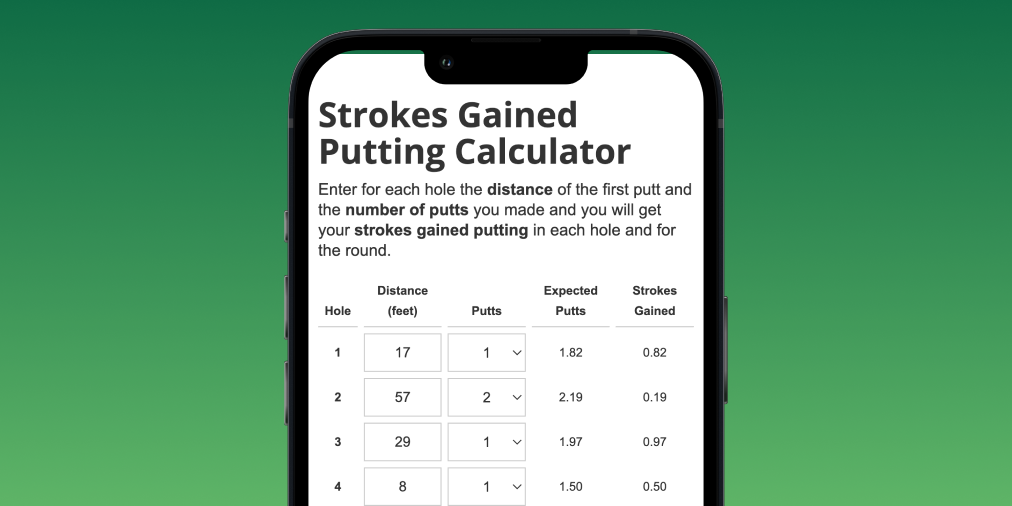
For quick calculations without creating an account, use our strokes gained putting calculator. Enter a distance and see exactly how many putts you’re expected to take, then calculate your gain or loss.
Understanding the Research Behind Putts Gained
Broadie’s putting research built on his earlier work establishing the strokes gained methodology. His book “Every Shot Counts” explains the full research in accessible terms. For the original academic paper, see his article Assessing Golfer Performance Using Golfmetrics.
The PGA Tour adopted strokes gained as an official statistic in 2011, and today it’s considered the gold standard for measuring professional golf performance. With golfity, you can apply the same analysis to your own game.
Start Measuring Your True Putting Ability
Ready to see how your putting actually measures up? Sign up for golfity and track your next round. Enter your putt distances, and you’ll have putts gained data that tells you exactly where you stand.
For more on the complete strokes gained system, see what is strokes gained or explore how to calculate strokes gained with examples.