
Scorecard with Strokes Gained: See Your Golf Stats by Hole
View strokes gained by category (OTT, APP, ARG, PUTT) for each hole with the golfity enhanced scorecard view.
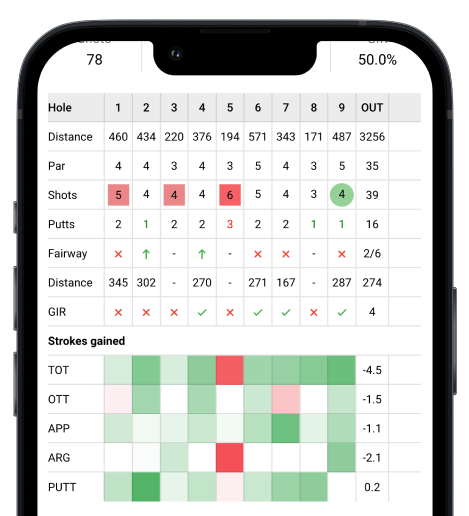
When you open the stats for any round in golfity, the first thing you see is an enhanced scorecard that goes far beyond traditional scoring. This “scorecard on steroids” combines the familiar scorecard layout with complete strokes gained analysis for every hole.
What the Enhanced Scorecard Shows
The golfity scorecard displays two categories of information for each hole:
Traditional Statistics
- Hole info: Distance and par
- Shots: Total strokes taken
- Putts: Number of putts
- Fairway: Whether you hit the fairway (par 4s and 5s)
- Drive distance: How far your tee shot traveled
- GIR: Green in regulation status
Strokes Gained Breakdown
Following the PGA Tour’s four-category system:
- TOT: Total strokes gained for the hole
- OTT: Off-the-tee (driver and tee shots on par 4s/5s)
- APP: Approach shots
- ARG: Around-the-green (within 30 yards of the green)
- PUTT: Putting performance
Reading the Color-Coded Results
The scorecard uses intuitive color coding:
- Green cells: Positive strokes gained (better than baseline)
- Red cells: Negative strokes gained (worse than baseline)
- Deeper colors: Larger gains or losses
Click any cell to see the exact strokes gained value. This helps distinguish between a -0.1 (minor loss) and a -1.5 (significant problem).
Real Example: Analyzing a Round

Here’s an actual round from golfity showing 78 strokes (8 over par):
Summary stats:
- 31 putts
- 7/13 fairways hit (54%)
- 244 yards average drive
- 9 greens in regulation
Strokes gained totals:
- OTT: -3.0 strokes
- APP: -1.3 strokes
- ARG: -3.6 strokes
- PUTT: -1.2 strokes
Identifying Problem Areas
Two triple-bogeys stand out on holes 5 and 11:
Hole 5 (par 3): The ARG column shows deep red, indicating the player lost significant strokes around the green. On a par 3, this typically means a missed green followed by poor chipping or a failed up-and-down attempt.
Hole 11: Red cells appear in both OTT and ARG columns. A poor drive put the player in trouble, and short game errors compounded the problem.
Category-Level Insights
Looking at the round totals in the rightmost column reveals a clear pattern:
The worst categories are driving (-3.0) and around-the-green (-3.6). Combined, these cost the player 6.6 strokes against baseline performance.
Approach shots (-1.3) and putting (-1.2) show relatively solid performance. While still negative (this player shoots above scratch), these areas are not the primary score-killers.
Using Scorecard Data for Practice Planning
This analysis points to specific practice priorities:
- Short game work: With -3.6 strokes around the green, this player should spend significant practice time on chips, pitches, and bunker shots within 30 yards
- Driver accuracy: The -3.0 OTT strokes suggest either directional issues or distance problems off the tee
- Approach and putting maintenance: These areas are performing adequately but shouldn’t be neglected
Without strokes gained data, this same round might lead to misleading conclusions. The player might focus on putting because “31 putts feels like too many” when putting was actually the second-best category.
Tracking Progress Over Multiple Rounds
The real power of the strokes gained scorecard emerges when you track multiple rounds. Patterns become clear:
- Is your OTT consistently negative, or was that one bad day?
- Does ARG improve when you practice your short game?
- Which holes at your home course always cause problems?
golfity aggregates this data across rounds so you can see trends over time, compare different courses, and measure the impact of swing changes or practice routines.
Getting Your Strokes Gained Scorecard
Every round tracked shot-by-shot in golfity automatically generates this enhanced scorecard. Start tracking your rounds to see exactly where you’re gaining and losing strokes—and build a data-driven improvement plan.
For manual tracking methods that feed into this analysis, see our guide on manual shot entry for strokes gained. You can also use the standalone strokes gained calculator to understand how individual shots contribute to your score.