
Golf Scorecard App vs Paper Scorecard: Which Should You Use?
Paper is fast, free, and gives you nothing back. A golf scorecard app costs a few taps per hole and gives you the rest of your game. Here is the honest comparison.
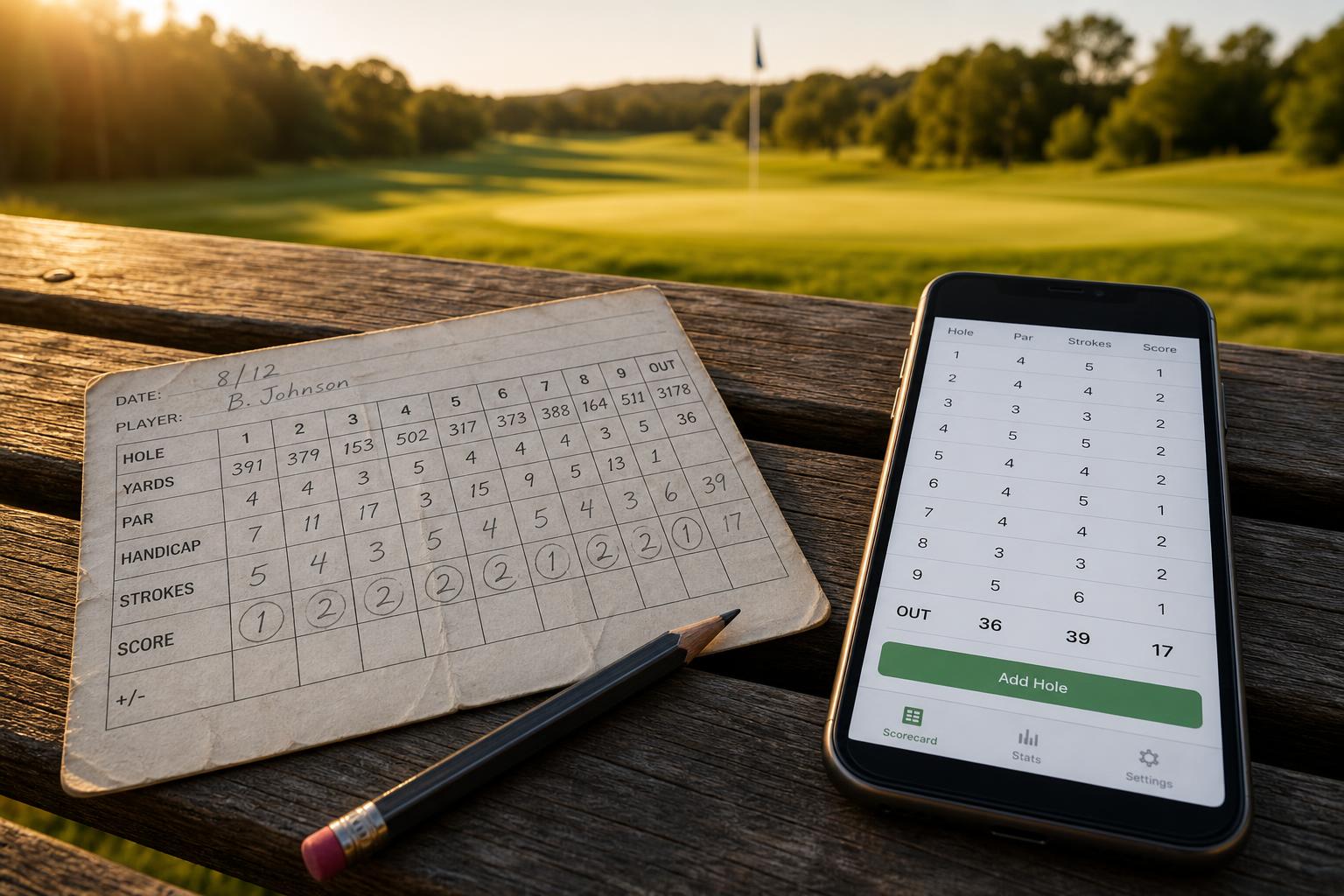
Every golfer has a scorecard ritual. Pencil tucked behind the ear, paper folded in the back pocket, a thumb that gets a little blacker as the round goes on. The paper scorecard has been the universal record-keeping device of golf for more than a century, and there is a reason it has lasted: it works.
A golf scorecard app is a different proposition entirely. It can record the same numbers — net, gross, points — and then go far past them, into the shot-by-shot world of strokes gained, club distances, putting performance, and round-over-round trends. For a small ongoing cost in taps, it gives you back the rest of your game.
So which one should you actually use? This post lays out the honest tradeoff. No marketing. The places where paper is genuinely better, the places where an app pulls away, and a practical framework for picking the right tool for the way you play golf.
What Each Tool Is Actually For
Before comparing the two, it helps to be precise about what each one does well.
A paper scorecard is a recording medium for the outcome of a hole: how many strokes you took, occasionally how many putts, sometimes whether you hit the fairway and green. It is designed to be filled in quickly, signed by a marker, and used to compute one or two numbers at the end — your gross score, your net score, maybe a Stableford total. It is a receipt.
A golf scorecard app is a recording medium for the contents of a round: the same totals, plus the location and result of every shot, the clubs you used, the distances you covered, and an automatic computation of the metrics that explain why your score ended up where it did. It is a record, an analyzer, and a coach in the same surface.
The two tools answer different questions. Paper answers what did I shoot today? An app answers what did I shoot today, and why, and what should I do about it?
Where Paper Wins
It would be dishonest to skip this section. Paper has real advantages, and a lot of golfers stick with it for very good reasons.
It is faster on the hole. A pencil mark takes a fraction of a second. Even the smoothest app needs a tap to open, a tap to log, a tap to confirm. For a player who already plays quickly, paper is the least disruptive option available.
It does not run out of battery. A 4.5-hour round at altitude on a cold morning will drain a phone fast. Paper does not care. If you play in conditions where your phone is in a hand-warmer pocket more than out of it, paper is unbeatable.
It is universally accepted. Tournament committees want a signed paper card. Club competitions, club championships, regional opens — most still run on paper as the official document, with apps used only for personal tracking alongside.
It is socially invisible. Pulling out a phone on the tee box can read, to some playing partners, as rude or distracted. A pencil and a card raises no eyebrows. For players who walk with people sensitive to that, paper avoids a conversation.
The cost is zero. Most courses hand cards out free. There is no subscription, no learning curve, no friction.
These are not small points. If your goal is simply to know what you shot and submit a score for your handicap, paper is a perfectly fine tool and there is no need to overcomplicate it.
Where Paper Stops
What paper cannot do is give you anything back. The card goes into a pocket, then a drawer, then a recycling bin. Every round is a one-time event. Patterns across rounds, leaks in specific parts of your game, distances per club — none of it is recoverable from a stack of cards, because none of it was ever recorded in the first place.
Think about what a typical paper card holds at the end of a round:
| Hole | Par | Score | FW | GIR | Putts |
|---|---|---|---|---|---|
| 1 | 4 | 5 | ✓ | 2 | |
| 2 | 3 | 4 | 3 | ||
| 3 | 5 | 6 | ✓ | ✓ | 2 |
This is enough to compute three numbers: total strokes (87, say), fairways hit (8/14), and total putts (34). That is all the structured information paper carries. The other 90+ pieces of information from the round — where exactly each shot started and finished, which club hit it, how close to the hole approach shots landed, how long putts were attempted from — exist only in your memory, and your memory will lose almost all of it by the next morning.
This is the trap. Paper is not a small version of an app. It is a fundamentally lower-resolution recording. The decisions you would want to make about your game next week — what to practice, which club to swing on the range, which yardage is leaking strokes — depend on data that paper cannot hold.
Where a Golf Scorecard App Wins
A golf scorecard app is a paper card plus a recorder. The “plus a recorder” part is where the leverage is.
It captures shot-level data. Every shot becomes a row: start lie, end lie, distance, club. That is the raw material every modern golf analytic is built on. Strokes gained, shot accuracy, club distances, scrambling — none of these exist without shot data. With it, all of them are free.
It computes strokes gained automatically. This is the single biggest reason an app pulls away from paper. Strokes gained is the most informative golf statistic ever published, and it is mathematically impossible to compute from a paper card. An app does it round-by-round, hole-by-hole, even shot-by-shot. See example of strokes gained calculation for what that math actually looks like.
It accumulates rounds. Twenty paper cards in a drawer are twenty receipts. Twenty rounds in an app are a dataset. The difference becomes obvious when you start asking real questions: am I better with my 7-iron or my 8-iron? What is my actual carry distance with driver? Has my putting improved this season? These questions take seconds to answer in an app. They are unanswerable from a stack of cards.
It surfaces leaks. With shot data and a benchmark, an app can tell you which part of your game is costing you the most strokes — and how that gap has been trending. Strokes gained vs traditional golf stats explains why this is so much more useful than fairways and greens alone.
It lets you skip what you don’t want. Modern apps don’t force you to log everything. You can skip club selection and accuracy tracking and still get strokes gained, or you can go full detail when you want it. The system meets you at whatever speed you want to play.
It exports cleanly. Your data is portable. Most apps, including golfity, let you export your scores to spreadsheets or share rounds with a coach. Paper cards can do neither without manual re-entry.
The headline tradeoff is simple: an app costs you a handful of taps per hole and gives you, in return, every metric that has been shown to actually predict scoring.
The Time Cost, Honestly
The most common objection to a scorecard app is “I don’t want to slow down the round.” Fair. Let us look at the actual numbers.
For a player using golfity at the minimum-detail setting (score only, no shot tracking), the per-hole cost is one tap to open the app, one to log the score, and one to confirm. About 3 seconds per hole, or 54 seconds per round. That is faster than writing scores on a paper card, because there is no pencil-and-card juggling.
For shot-by-shot tracking with no club selection or accuracy data:
| Action | Approx. time per hole |
|---|---|
| Open app | 1s |
| Log 5 shots | 8-12s |
| Confirm hole | 1s |
| Total | ~10-14s per hole |
Over 18 holes, that is roughly 3-4 minutes of total interaction with the phone across a 4.5-hour round. That is less time than most players spend looking for one lost ball.
If you also log club and accuracy for every shot — the maximum detail mode — the cost climbs to roughly 20-25 seconds per hole, or about 6-7 minutes of tapping across an entire round.
The argument that an app slows down play is sometimes true and sometimes a story. It is true if you are still learning the interface or trying to remember exactly where every shot finished. It becomes untrue within about 5 rounds of practice. The pace-of-play studies that exist on this — including data from clubs that have measured rounds with and without app users — show no measurable difference in pace for experienced app users.
For a closer look at how to keep tracking light and fast, see the beginner’s guide to tracking golf scores without slowing down.
What Each Tool Tells You at the End of a Round
This is the cleanest way to see the difference. Here is what each tool gives you back after you walk off 18 holes shooting 87 with a 16 handicap:
Paper scorecard:
- Hit 8/14 fairways. 5/18 greens. 34 putts.
That is it. Three numbers. A score, a fairway count, a putt count. You could derive a few more by hand — front nine 44, back nine 43, double-bogeys on 4 and 12 — but anything beyond that, the card cannot answer.
Golf scorecard app (golfity):
87 (+15). Strokes Gained Off the Tee: -1.6 vs 10 handicap. SG Approach: -3.4. SG Around the Green: -0.8. SG Putting: +0.2. Strongest hole: 7. Weakest hole: 12. Worst club: 8-iron (-2.1 across 5 shots). Best club: 56° wedge (+0.6 across 4 shots). 3-putts: 1. Up-and-down rate: 2/5. Average drive: 232y. Average approach proximity from 150-175y: 41 feet.
That is the same round. Same 87. But now there is a story. Approach play is the leak. The 8-iron specifically is dragging the round down. Putting is, surprisingly, the strongest part of the game today. The 7th hole worked, the 12th did not. There is a clear answer to the question “where should I practice this week,” and it has nothing to do with putting drills.
This is what “captures your game” means. The score is the same. The information content is not in the same universe.
A Third Option: Use Both
The serious answer to “paper or app?” is, for some golfers, both. Paper goes in the back pocket and gets filled out as you go, the way it always has. The app runs in parallel, capturing the shot-level data. At the end of the round, paper gets signed and submitted to the committee or the handicap system, the app gets reviewed for what actually happened.
This is the setup most touring pros and serious amateurs in tournaments use — a paper card as the official record, a tracking app as the analytical record. The two do not conflict. They answer different questions on different timescales.
For non-tournament rounds, most players eventually drop the paper because the app does the official record job too. The official handicap submission can be made directly from the app’s score, with no paper intermediary. But there is no obligation to skip paper while you’re getting comfortable with an app. The two coexist for as long as you want them to.
Picking the Right Tool
A reasonable decision framework, based on what you actually want from your golf:
Use paper if:
- You only care about your gross score and your handicap.
- You play tournaments where paper is the official medium and you don’t track outside competition.
- Your phone genuinely cannot survive a round in your conditions.
- You play with partners who you know would find a phone disruptive, and you’d rather keep the peace.
Use a golf scorecard app if:
- You want to know which part of your game is costing you strokes.
- You are trying to lower your handicap and need data to direct your practice.
- You have ever wondered what your real club distances are.
- You want to see whether the work you put in actually moves the needle.
- You are willing to spend 3-5 minutes of cumulative tapping per round in exchange for a complete record.
Use both if:
- You play tournaments but also care about analytics.
- You are new to apps and want the safety net of paper while you learn.
- Your phone battery sometimes fails and you want a backup official record.
There is no universally right answer. There is only the answer for the way you play, and the questions you want your golf data to answer for you over the next year.
The Long View
Paper has been around for over a century. It has worked, and for a particular kind of golfer with a particular set of goals, it will keep working. Nothing in this post should read as “throw away your scorecards.”
But the questions golfers care about have changed. Did I beat my partner? is still a question, but it has been joined by which 50 yards of the course owe me the most strokes? and should I be hitting more 9-irons than 8-irons from 145? and has my putting actually improved since March? These are not exotic questions anymore. They are the standard questions that any improving amateur asks, and they map perfectly onto the kind of data a scorecard app captures and the kind of data paper does not.
If you have spent years filling out paper cards and never opened an app, try one for ten rounds. Use the minimum-detail mode. Don’t worry about precision on every shot. Just see what your golf looks like when there is a record of it that survives the round. Then read the data once, look at where the strokes are leaking, and pick one thing to practice.
That is what a golf scorecard app does for you that paper never could. Same round, same shots, same score. Completely different conversation about what to do next.