Strokes Gained vs Traditional Golf Stats: Which Is Better?
Traditional golf stats have been around for decades, but strokes gained is changing how golfers understand their performance. Here is why the two approaches tell very different stories.

You finish a round and check your stats: 8 fairways, 10 greens in regulation, 32 putts. Decent numbers. But you shot 82 and your buddy who hit 6 fairways and 8 greens shot 78. What happened?
Traditional golf stats can’t answer that question. Strokes gained can.
What Traditional Golf Stats Measure
Traditional stats count outcomes. Fairways hit, greens in regulation, putts per round, scrambling percentage. These numbers have been the language of golf for decades because they are simple to track and easy to understand.
But simplicity comes at a cost. Traditional stats treat every outcome the same:
- Fairways hit counts a 300-yard drive down the middle the same as a 220-yard punch that stays in the short grass. It also counts a miss into light rough the same as a miss into the trees.
- Greens in regulation doesn’t distinguish between hitting it to 5 feet and hitting it to 50 feet. Both count as a GIR.
- Putts per round penalizes great approach players who hit more greens (and therefore putt more) while rewarding poor approach play that leads to chips and one-putts.
These stats tell you what happened, but they don’t tell you how well it happened.
What Strokes Gained Measures
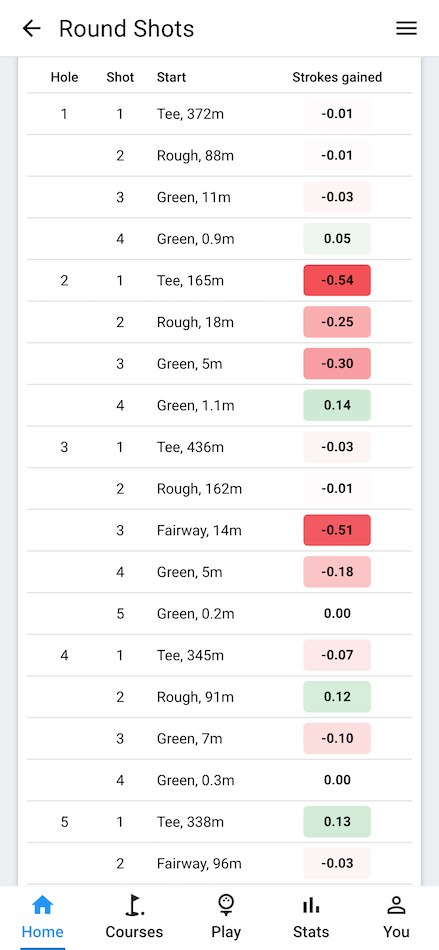
Strokes gained measures quality. Developed by Columbia professor Mark Broadie and adopted by the PGA Tour, it compares every shot you hit against a benchmark—what a tour player would expect to score from the same position.
The result is a single number for each shot that tells you exactly how much that shot helped or hurt your score.
Consider two drives:
- Drive A: 280 yards, center of the fairway. Strokes gained: +0.3
- Drive B: 260 yards, left rough. Strokes gained: -0.1
Fairways hit sees one good drive and one bad drive. Strokes gained sees a great drive and a slightly below-average drive. The difference matters when you are deciding where to practice.
A Head-to-Head Comparison
| Aspect | Traditional Stats | Strokes Gained |
|---|---|---|
| What it measures | Outcomes (yes/no) | Quality (how much better/worse) |
| Precision | Binary—hit or miss | Continuous—exact value of every shot |
| Cross-category comparison | Impossible to compare putting vs driving | Direct comparison across all categories |
| Practice direction | Vague—“hit more greens” | Specific—“your approach game costs you 2.1 strokes per round” |
| Sample needed | Any number of rounds | 5+ rounds for reliable patterns |
| Ease of tracking | Score and putts per hole | Shot-by-shot with club, lie, and distance |
Where Traditional Stats Mislead You
The Putting Trap
A golfer averaging 30 putts per round looks like a great putter. But what if their average first putt is from 25 feet because their approach shots are mediocre? Those 30 putts might actually represent above-average putting from long distances—and the real problem is iron play, not the flat stick.
Strokes gained putting isolates putting performance from approach quality. It compares each putt to what the benchmark says you should take from that distance, regardless of how you got there.
The Fairway Illusion
Hitting 10 of 14 fairways sounds solid. But if those 10 fairways came from laying back with a 3-iron while the misses were only a yard into light rough, your tee game might not be as strong as the number suggests. Meanwhile, a player hitting 7 fairways with a driver might be gaining more strokes off the tee because their drives that find the fairway leave much shorter approaches.
Strokes gained off the tee accounts for both distance and accuracy. It answers the full question: “How good was that tee shot, really?”
The GIR Problem
Greens in regulation conflates two very different outcomes. Hitting the green to 6 feet and hitting the green to 45 feet both count the same, but the expected score from each position is dramatically different. The player who hits 10 greens to an average of 35 feet might score worse than the player who hits 8 greens to an average of 12 feet.
Strokes gained approach measures proximity and lie, giving you the true value of each approach shot.
Why Strokes Gained Is Better for Improvement
The biggest advantage of strokes gained is actionable feedback. When you know your strokes gained breakdown:
- Off the tee: +0.5 — Your driving is above average. Maintain it.
- Approach: -2.1 — This is where you’re bleeding strokes. Focus practice here.
- Around the green: +0.3 — Your short game is solid.
- Putting: -0.4 — Slightly below average. Work on lag putting from long distance.
You now know exactly where to spend your practice time. Traditional stats would tell you to “hit more greens,” but strokes gained tells you your approach play from 150–200 yards in the fairway is specifically where you’re losing the most strokes.
That precision is what makes strokes gained the preferred metric for PGA Tour coaches and data-driven amateurs alike.
Do You Still Need Traditional Stats?
Traditional stats aren’t useless. They provide a quick snapshot and they’re easier to track during casual rounds. If you’re playing a quick 9 holes and just want to log your score and putts, that’s still valuable data for tracking trends.
The best approach is to use both:
- Track traditional stats for every round—they take minimal effort
- Track shot-by-shot for practice rounds and rounds where you want full analytics
- Use strokes gained data to guide your practice and identify real weaknesses
golfity supports all three tracking modes—total score only, hole-by-hole, and full shot-by-shot—so you can choose the right level for each round.
Try It Yourself
Use the strokes gained calculator to see how individual shots compare to the benchmark. Then track a few rounds shot-by-shot in golfity to get your personalized strokes gained breakdown.
After five rounds, you’ll have a clear picture of where your game stands—and more importantly, where to focus to lower your scores fastest.
The numbers don’t lie. And strokes gained tells you what the numbers actually mean.