
Why You Should Track Your Golf Scores: 5 Benefits That Improve Your Game
Discover the key benefits of tracking your golf scores - from identifying areas for improvement to making the game more enjoyable.
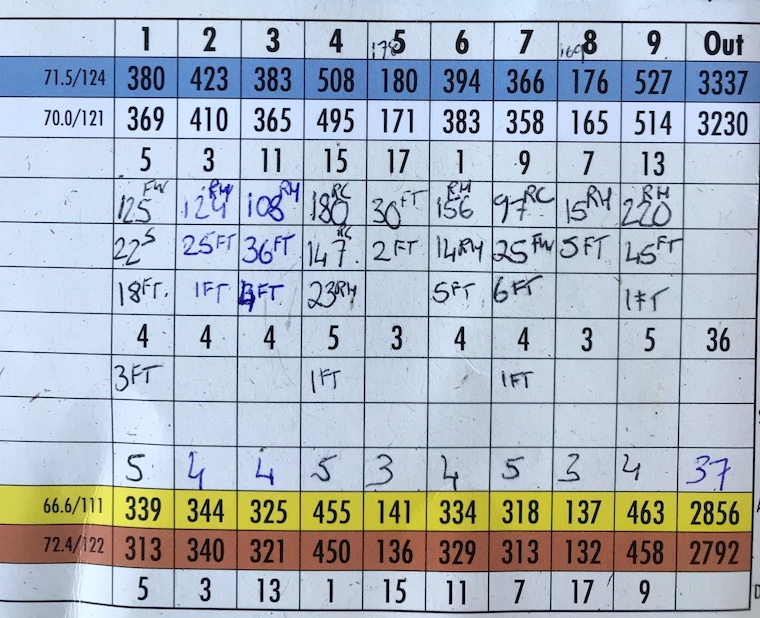
Tracking your golf scores transforms casual play into purposeful improvement. Every round generates data that reveals your strengths, exposes your weaknesses, and guides your practice sessions. Players who track consistently improve faster than those who rely on memory and gut feelings.
1. Identify Your Real Weaknesses
Most golfers misdiagnose their problems. A player who misses putts might blame their putting stroke when the real issue is approach shots that leave difficult first putts. Score tracking with shot-level data exposes the truth.
When you track where each shot lands and how many strokes it takes, patterns emerge:
- Are you losing strokes off the tee or on approaches?
- Do you struggle from specific distances?
- How does your short game compare to your full swings?
Strokes gained analysis answers these questions with precision. Instead of guessing where you need work, the data shows exactly which parts of your game cost you the most strokes.
2. Measure Progress Over Time
Memory deceives us. Last month’s rounds blur together. That stretch of good play fades while recent struggles dominate your thinking.
Tracking creates an objective record. You can compare:
- Scoring averages by month, season, or year
- Performance on specific hole types (par 3s, par 5s, dogleg lefts)
- Improvement in specific skills after focused practice
- Results at particular courses over multiple visits
When you hit a goal, the data confirms your progress. When improvement stalls, the numbers point you toward the next area to address.
3. Set Realistic Goals
Without data, goals become arbitrary. “I want to break 90” sounds reasonable, but where will those strokes come from?
Tracking reveals the path. If your strokes gained data shows you lose 3 strokes per round putting from inside 10 feet, you have a specific, actionable goal. Practice 10-footers, track your make percentage, and watch your scoring average drop.
Data-driven goals include:
- Reduce three-putts from 3 per round to 1 per round
- Improve fairways hit from 40% to 55%
- Decrease penalty strokes by 50%
- Lower your strokes gained benchmark to the next handicap level
4. Make Smarter Decisions on the Course
Historical data informs in-round strategy. If you know you hit 70% of fairways with your 3-wood but only 45% with driver, club selection becomes easier on tight holes.
Tracking also reveals tendencies you might not notice:
- Do you play better in the morning or afternoon?
- How does wind affect your scoring?
- Which holes consistently cost you strokes?
- Do you perform better playing aggressively or conservatively?
Armed with this information, you can adjust your game plan before stepping onto the first tee.
5. Add Enjoyment and Competition
Golf provides more engagement when you have something to measure beyond the final score. Tracking turns every round into a source of information and accomplishment.
Score tracking also enhances the social side of golf:
- Compare stats with playing partners
- Set up friendly competitions based on specific metrics
- Share achievements when you hit milestones
- Build a history of your golf journey
Many top amateurs and professionals swear by tracking their scores as an essential part of their development.
What to Track for Maximum Benefit
Basic tracking captures scores by hole. Advanced tracking adds the data that powers real insight:
Essential data points:
- Score on each hole
- Number of putts
- Fairways hit (yes/no)
- Greens in regulation (yes/no)
Advanced data points:
- Shot locations (distance and lie)
- Club used for each shot
- First putt distance
- Strokes gained by category
golfity captures all of this automatically. Enter your shot locations, and the app calculates strokes gained for every part of your game. You get tour-level analytics without tour-level effort.
Getting Started with Score Tracking
The best time to start tracking was your first round. The second-best time is your next round.
Download golfity and enter your shots as you play. The app handles the analysis and presents your data in clear, actionable formats. After a few rounds, you will have the insights needed to practice smarter and play better.
Your scores tell a story. Tracking ensures you can read it.