
Putts by Distance: Analyze Your Putting Performance in golfity
Analyze your putting performance by distance with detailed charts showing your one-putt, two-putt, and three-putt percentages.
Raw putt counts tell you almost nothing useful about your putting. Averaging 32 putts per round sounds mediocre—but what if you’re consistently leaving yourself 40-foot birdie putts? That same golfer averaging 28 putts might just be chipping closer.
golfity’s putts by distance analysis solves this problem. By tracking where your putts start and how many strokes you need from each distance, you get a true picture of your putting performance.
Understanding the Putts by Distance Chart
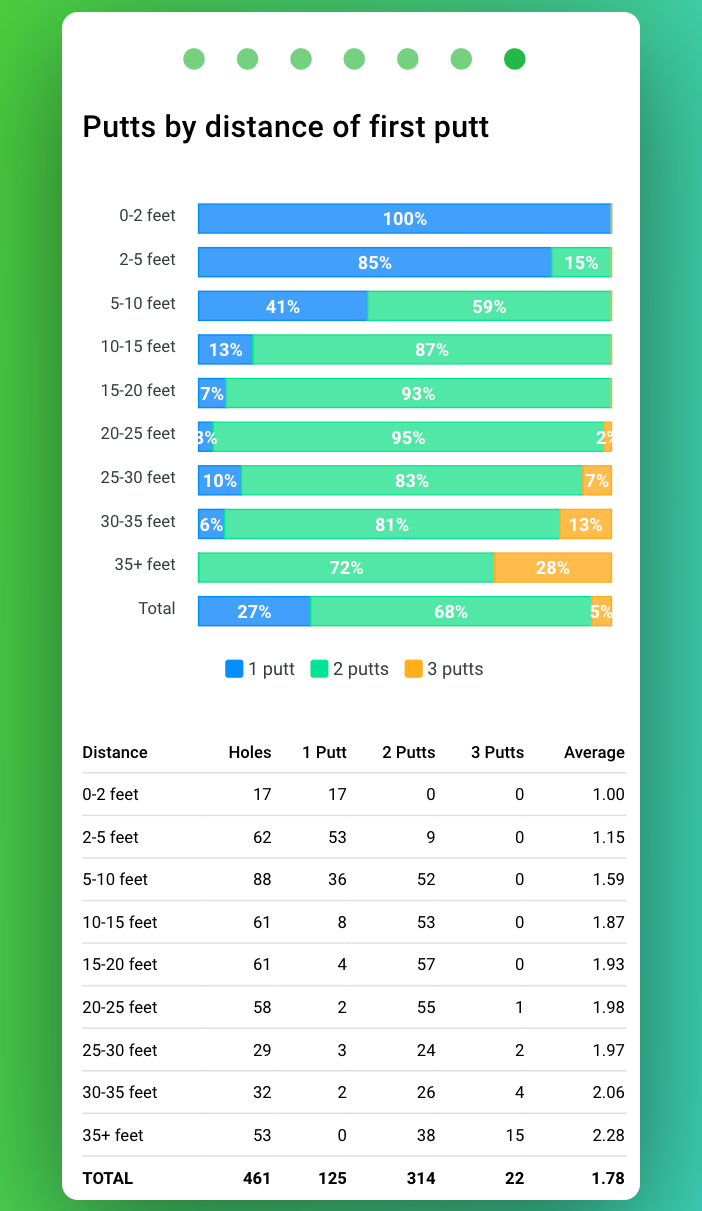
The putts by distance feature shows your percentage of one-putts, two-putts, three-putts, and four-putts broken down by starting distance ranges.
Here’s example data from one of our users:

The Total row shows aggregate performance: this golfer three-putts only 5% of the time (22 instances). Strong performance by any measure.
But the distance breakdown reveals more:
- Under 20 feet: Zero three-putts—excellent short-range lag putting
- 20-35 feet: Occasional three-putts, generally solid
- 35+ feet: Three-putts 28% of the time—potential improvement area
Without distance context, you can’t identify these patterns. You might blame your putting when the real issue is approach shots leaving 40-footers instead of 20-footers.
Putts to Hole: Average Strokes by Distance
The analysis also shows putts to hole—the average number of strokes needed to finish from each distance range.
| Distance Range | Putts to Hole |
|---|---|
| 0-5 feet | 1.08 |
| 5-10 feet | 1.42 |
| 10-15 feet | 1.68 |
| 15-20 feet | 1.85 |
| 20-25 feet | 1.98 |
| 25-35 feet | 2.12 |
| 35+ feet | 2.28 |
Compare your numbers to these benchmarks. If you’re taking 1.25 putts from 0-5 feet (missing one-in-four shorties), that’s a glaring issue to address. If you’re at 2.0 putts from 35+ feet, you’re actually outperforming expectations.
How Putts by Distance Connects to Strokes Gained
Mark Broadie’s strokes gained research established baseline expectations for putting from every distance. A 10-foot putt should take an average of 1.61 strokes for a scratch golfer. Make it in one, you gain 0.61 strokes. Three-putt, you lose 0.39 strokes.
golfity’s putts by distance analysis feeds directly into your strokes gained putting calculation. Together, these metrics answer crucial questions:
- Am I losing strokes with the flatstick? Compare your putts to hole against baseline expectations.
- Where specifically am I losing strokes? The distance breakdown pinpoints trouble ranges.
- Is my putting improving? Track your putts by distance over time to measure progress.
Traditional putting stats like “putts per round” or “putts per GIR” can’t answer these questions because they ignore starting distance—the most important factor in expected outcome.
Finding Your Putting Weaknesses
Most golfers have specific distance ranges where they struggle. Common patterns include:
Short putt problems (0-5 feet): High pressure, poor mechanics, or rushing. These missed putts are devastating because you should make nearly all of them.
Mid-range struggles (10-20 feet): This is where scoring putts live. Poor performance here means missed birdie opportunities and more bogeys from marginal GIR positions.
Lag putting weakness (30+ feet): If you’re frequently three-putting from long range, focus on speed control rather than line. Most long-range three-putts come from leaving the first putt too short or racing it too far past.
The putts by distance chart makes these patterns visible. Track enough rounds and you’ll see exactly where to focus your putting practice.
Practicing with Purpose
Once you identify your weak distance ranges, practice becomes more effective:
Measure your practice putts. Set up at 8 feet, 15 feet, and 30 feet. Track your make percentage and average putts to hole from each distance.
Compare practice to course performance. If you drain 70% of 8-footers in practice but only 50% on the course, the issue isn’t mechanics—it’s pressure management.
Focus on speed from long range. For putts over 30 feet, success means two-putting. Practice lag putting with a focus on leaving the ball within 3 feet.
Get Your Putting Data
Ready to understand your putting beyond basic stats? Sign up for golfity and track your rounds with putt distances. After a few rounds, you’ll have actionable data showing exactly where your putting helps and hurts your scores.
Stop guessing about your putting. Let the data show you where to improve.