Shot Tracking App vs Manual Round Entry: Which Is Better for You?
One captures every shot and hands you strokes gained. The other logs your score in seconds and moves on. Here is how to choose the right tracking depth for your golf.

There are two very different ways to record a round of golf on your phone, and golfers constantly confuse them. One is manual round entry: you type in what you shot on each hole, maybe your fairways, greens, and putts, and you’re done in under a minute. The other is a shot tracking app: you record where every individual shot started and finished, and the software turns that into strokes gained and a shot-level picture of your game.
These are not two brands competing. They are two depths of tracking, and most modern apps — golfity included — let you choose between them round by round. The real question is not “which app,” it’s “how much detail do I want to capture today?” This post lays out the honest tradeoff so you can pick the right depth for the way you actually play.
What Each One Actually Records
Manual round entry captures the outcome of your golf. You walk off the 18th and enter: 89, hit 7 fairways, 6 greens, 33 putts. That is a complete, useful record of what happened. It computes your score, your handicap differential, and a handful of traditional stats. It does not know how you got there.
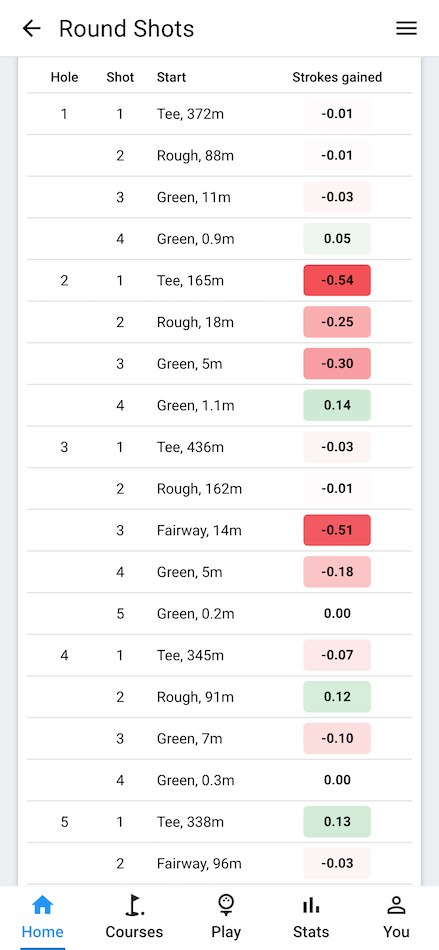
A shot tracking app captures the contents of your golf. Every shot becomes a row of data: start lie, distance to the hole, and result. From 40 or so shots per round, it reconstructs the entire hole and computes strokes gained for every one of them. It knows that your second shot on the 4th flew 165 yards from the fairway to 38 feet, and it knows exactly how many strokes that shot gained or lost against a golfer at your level.
The gap between the two is enormous. Manual entry gives you three or four numbers. Shot tracking gives you the raw material behind every modern golf statistic ever invented.
The Case for Manual Round Entry
It would be dishonest to pretend the fast option has no merit. Manual round entry wins on the things that matter to a lot of golfers.
It’s genuinely fast. In golfity’s quick mode, logging a round is a matter of tapping in hole scores. You can do it on the drive home or during a beer at the turn. There is no per-shot decision, no distance to remember, no rhythm to break.
It’s frictionless during the round. Because you’re only recording outcomes, you never touch your phone between shots. Your attention stays on the golf. For players who find any mid-hole phone use disruptive, this is the whole game.
It still builds a handicap and a trend. Round-level data is enough to track your scoring average, your handicap, and whether you’re improving over a season. If your only goal is “am I getting better,” manual entry answers it.
It never intimidates. New golfers who feel overwhelmed by shot-by-shot detail can start here, get comfortable, and add depth later. There’s no wrong way to log a score.
If you want a lightweight record and nothing more, manual round entry is not a compromise. It’s the correct tool.
Where Manual Entry Runs Out
The limitation is simple: manual round entry cannot tell you why you shot what you shot. It has no shot data, so it has no strokes gained, no club-level breakdown, and no way to separate a bad ball-striking day from a bad putting day.
Consider two golfers who both shot 89 and both hit 6 greens. On paper they had identical rounds. In reality, one missed every green by 10 feet and three-putted twice; the other missed greens by 40 feet but scrambled beautifully. Their practice priorities are opposite. Manual entry flattens them into the same three numbers and tells neither one what to work on.
This is the ceiling. You can enter rounds manually for years and still not know your real driver distance, which wedge yardage leaks strokes, or whether your putting is actually good. Those answers live in shot data, and manual entry never records it.
The Case for a Shot Tracking App
A shot tracking app exists to answer the question manual entry can’t: where are my strokes actually going?
It computes strokes gained automatically. Strokes gained is the most informative statistic in golf, developed from Mark Broadie’s research on hundreds of thousands of shots. It is mathematically impossible to compute without shot-level data. A shot tracking app produces it for every round, every category, and every club. If you’re new to the metric, what is strokes gained walks through the basics.
It finds your leaks. With a benchmark to compare against, the app tells you which part of your game is costing the most — off the tee, approach, around the green, or putting. For most amateurs this is a genuine surprise. The stat everyone obsesses over is rarely the one draining the round.
It builds a club dataset. After a handful of tracked rounds you get real stats per club: actual carry distances, which irons perform, and where the gaps in your bag sit. This is information paper and manual entry simply cannot hold.
It measures whether practice works. Because the data is consistent round to round, you can see if the work you put in on the range actually moves your approach numbers. That feedback loop is the entire point of tracking.
The cost is a few taps per hole and a little discipline about recording shots. In return you get every metric shown to predict scoring.
Automatic Sensors vs Manual Shot Entry
There’s a common assumption that shot tracking requires sensors — a chip in every grip that logs shots for you. Systems like Arccos and Shot Scope work that way, and they remove the in-round effort entirely. They also cost more, require charged hardware in every club, and can miss or misread shots that you then have to fix later. Our Arccos vs Shot Scope vs golfity comparison breaks down those tradeoffs in detail.
golfity takes the manual shot entry route: no sensors, no hardware, no subscription to a chip. You record shots yourself, either tapping them in during the round or noting distance and lie on your scorecard and entering them afterward. Our guide to manual shot entry for strokes gained shows exactly how. It’s more effort than a sensor and far cheaper, and it forces a useful review of your round when you enter the data.
You can also meet in the middle. golfity lets you skip club selection and accuracy tracking and still get full strokes gained — you record the shots, but not every attribute of each one. That keeps the effort low while preserving the metric that matters most.
How to Choose Your Depth
You don’t have to commit forever. A reasonable framework:
Use manual round entry if:
- You want a fast score log and a handicap, nothing more.
- Any mid-round phone use breaks your focus.
- You’re brand new to tracking and want to start simple.
Use a shot tracking app if:
- You want to know which part of your game is costing you strokes.
- You’re trying to lower your handicap and need data to aim your practice.
- You’ve ever wondered what your real club distances are.
Mix both if:
- You track shots for the rounds that matter and log casual rounds quickly.
- You want strokes gained without recording every shot attribute — use golfity’s lighter tracking mode.
Most golfers who start with manual entry and try shot tracking for ten rounds never fully go back, because the first time an app tells you your approach play is the leak — not your putting, which you assumed — the number changes how you practice. But there’s no obligation to track deeply on a Sunday scramble. The right depth is the one you’ll actually keep using.
The Bottom Line
Manual round entry and a shot tracking app are answering different questions. One tells you what you shot. The other tells you what you shot, why, and what to fix. Neither is universally correct — the fast log is perfect for some rounds and some golfers, and the full record is transformative for anyone chasing a lower handicap.
The good news is you don’t choose once. With golfity’s tracking modes you pick the depth per round, and you can start light and go deeper the moment you want the strokes gained picture. Try shot tracking for a few rounds, read where your strokes are actually leaking, and pick one thing to practice. Same golf, completely different conversation about how to get better.