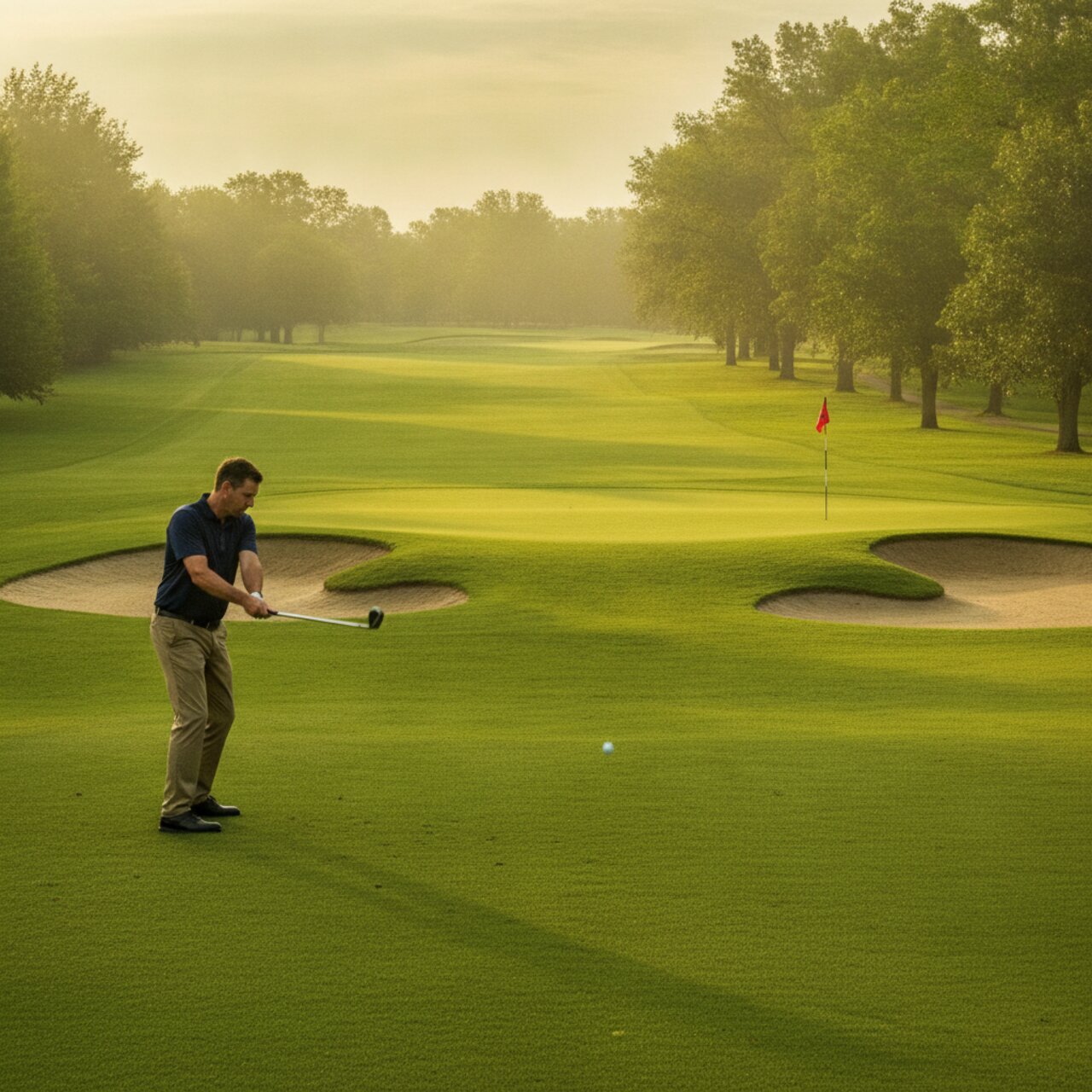
What Does a Scratch Golfer Shoot? Average Score and Stats of a 0 Handicap
A scratch golfer averages 74 to 76, not par. Here is the stat line behind a 0 handicap, side by side with every handicap from 5 to 30.
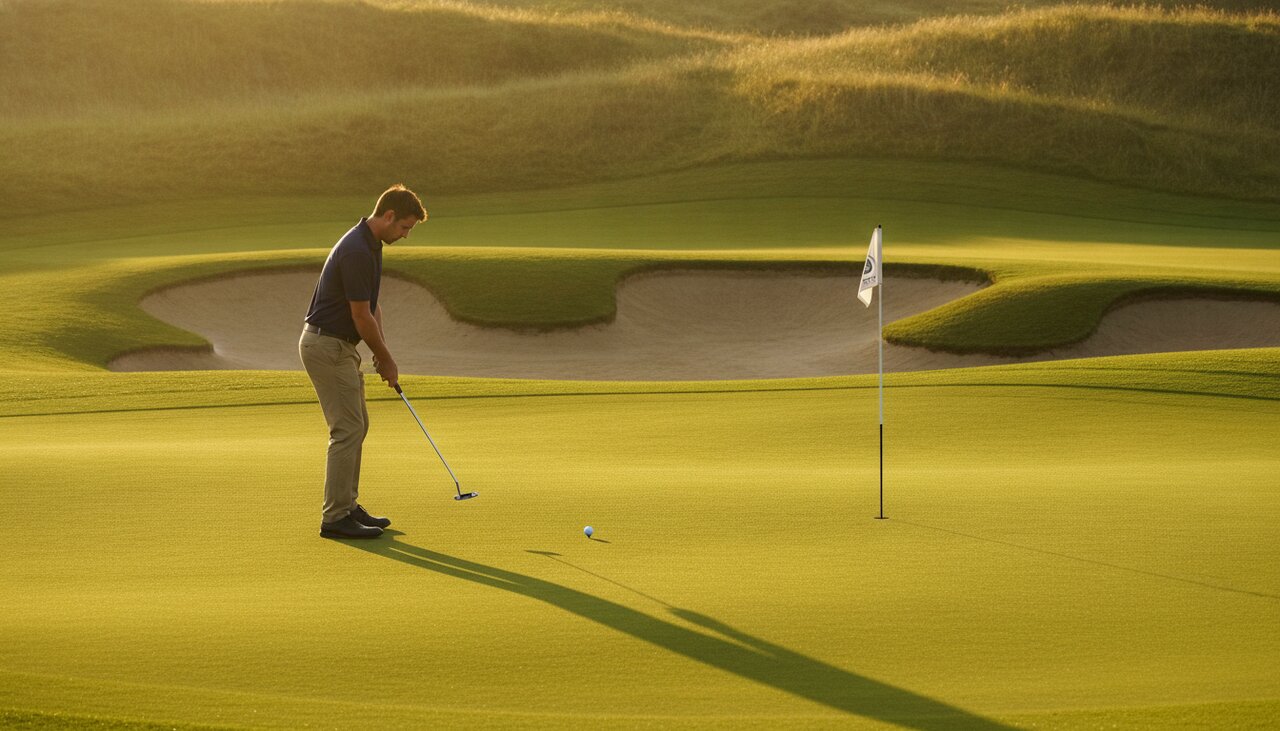
A scratch golfer typically shoots 74 to 76 on a par-72 course, and most of their rounds fall between 72 and 79. Par is a good day for a 0 handicap, not a normal one, because a handicap index is built from your best 8 of your last 20 rounds.
Scratch is also rare. The USGA puts 2.01% of male and 0.85% of female index holders in the US at 0 or better, per our breakdown of what a good golf handicap is. Here’s how a scratch golfer’s scores compare to every other level, and the stat line that produces them.
Scratch golfer average score compared to other handicaps
| Handicap | Typical score | Most rounds | Greens in regulation | Putts per round | Strokes gained vs PGA Tour |
|---|---|---|---|---|---|
| Scratch (0) | 74–76 | 72–79 | 62% | 30.5 | -3.2 |
| 5 | 79–81 | 77–85 | 46% | 31.5 | -6.2 |
| 10 | 84–87 | 82–91 | 35% | 32.5 | -9.2 |
| 15 | 90–92 | 87–98 | 23% | 33.5 | -12.2 |
| 20 | 95–98 | 92–104 | 16% | 34.5 | -15.2 |
| 25 | 100–103 | 97–110 | 9% | 35.5 | -18.4 |
| 30 | 105–108 | 101–116 | n/a | n/a | -21.5 |
Scores come from our average score by handicap table, putts from our putting average benchmarks, and strokes gained from the Broadie-based benchmarks for every handicap. Greens in regulation come from Shot Scope’s published amateur data, which stops at 25, so the 30-handicap cells stay blank.
A scratch golfer is about 5 strokes ahead of a 5 handicap and still 5 or so behind a PGA Tour player, who averages 69 to 71. In strokes gained, they give up 3.2 strokes a round to the tour, about half of what a 5 gives up.
The full stat profile of a scratch golfer
Scoring
- Typical score: 74–76, with most rounds between 72 and 79.
- By hole type: Shot Scope’s scratch golfer averages are 3.2 on par 3s, 4.2 on par 4s and 4.8 on par 5s. On a standard par 72 (four par 3s, ten par 4s, four par 5s) that adds up to 74.0, the low end of our range. Par 5s are the only hole type where a scratch golfer beats par on average.
- Birdies: 2.34 a round, per Shot Scope data published in our birdies and double bogeys by handicap table. A 5 makes 1.26 and the PGA Tour average is 3.72.
- Bogeys: 3.87 a round.
- Doubles or worse: 0.27 a round, about one every four rounds. A 5 makes 1.44, so this is the stat that changes most between the two levels.
Off the tee
- Fairways hit: 50%, or 7 of 14, per Shot Scope. A 10 and a 25 handicap hit the same 50%, as our fairways hit by handicap table shows. Accuracy isn’t what makes someone scratch.
- Driving distance: 285 yards with driver, Shot Scope’s “performance average,” which leaves out unusually long and short drives. That’s 24 yards past a 5 and 60 past a 20, per our driving distance by handicap table. The USGA and Arccos all-golfer figures put scratch nearer 250, because they measure every drive.
- What the drive leaves: on Shot Scope’s 420-yard par 4, the scratch golfer has 135 yards in, a pitching wedge. A 5 has a 7 iron from 159.
- Strokes gained off the tee: -0.8.
Approach
- Greens in regulation: 62%, or about 11 greens a round, per our greens in regulation by handicap table. Shot Scope’s scratch page gives a slightly lower 59%. The two come from different samples, and the gap is about half a green a round.
- Greens hit from 100 yards in the fairway: 74%. A 5 hits 65% from there and a 25 hits 36%.
- Greens hit on the 420-yard par 4: 58%, against 37% for a 5 and 27% for a 10.
- Strokes gained approach: -1.5, nearly half of the 3.2-stroke total. Approach is still the largest category at scratch, just as it is at every handicap.
Around the green
- Up and down from inside 50 yards: 54%, per our scrambling percentage by handicap table. That splits into 63% from inside 25 yards and 32% from 25 to 50 yards.
- Proximity from inside 50 yards: 11 feet, per Shot Scope. A 5 leaves it 14 feet away and a 10 leaves it 15.
- Sand saves: roughly 35–45%, per our sand save percentage benchmarks. That’s a rough range, not a measured average.
- Strokes gained around the green: -0.5.
Putting
- Putts: 30.5 per round, or 1.69 per hole. Per green in regulation, it’s 1.85, against 1.77 on the PGA Tour.
- Three-putts: about 0.8 per round, an avoidance rate near 96%, per our three-putt benchmarks. Shot Scope’s figure is 3% of holes, which works out to about 0.5 a round.
- Make rate from 0–6 feet: 93%, per Shot Scope. From 0–3 feet it’s 98%, and from 3–6 feet 76%. A 5 makes 67% from 3–6 feet, so this is where the scratch golfer’s putting edge shows up.
- Strokes gained putting: -0.4, the smallest category in the profile.
Penalties
- Penalty strokes: 0.56 per round, or about one every 32 holes, per Shot Scope’s amateur benchmarks in our penalty strokes per round by handicap table. A 5 takes 0.91 and a 10 takes 1.62.
Strokes gained for a scratch golfer, by category
| Category | Scratch | 5 handicap | 10 handicap |
|---|---|---|---|
| Off the tee | -0.8 | -1.4 | -2.0 |
| Approach | -1.5 | -3.0 | -4.5 |
| Around the green | -0.5 | -1.0 | -1.5 |
| Putting | -0.4 | -0.8 | -1.2 |
| Total | -3.2 | -6.2 | -9.2 |
These are per round, against a PGA Tour baseline, from Mark Broadie’s research. A scratch golfer is still negative in every category. What separates them from a 5 is that each category is roughly half the size. To see what one shot is worth from a given distance and lie, use the strokes gained calculator.
What separates scratch from a 5 handicap, and from the tour
From 5 to scratch:
- Score: about 5 strokes (79–81 vs 74–76).
- Greens in regulation: 46% vs 62%, about three more greens a round. It’s the biggest GIR jump between any two levels in the table.
- Driving distance: 24 yards (261 vs 285).
- Doubles or worse: 1.44 vs 0.27, more than one fewer a round.
- Approach: 1.5 strokes gained, half of the 3.0-stroke total gap.
- Fairways: 51% vs 50%. The 5 hits slightly more.
From scratch to the PGA Tour:
- Score: about 5 strokes (74–76 vs 69–71).
- Birdies: 2.34 vs 3.72 a round.
- Approach: 1.5 strokes gained, again nearly half the gap.
- Putting: 0.4 strokes gained, the smallest piece.
Both steps share the same shape. Approach is close to half the gap and putting is the smallest part. The statistical profile of a single-digit handicapper covers the range from scratch to 9. For the levels above, see what a 5 handicap, 10 handicap, 15 handicap, 20 handicap, 25 handicap or 30 handicap shoots.
How your numbers compare to a scratch golfer
The table describes a typical scratch player, not you. Two golfers who both average 75 can get there in different ways. One drives it 300 yards and hits 13 greens, and the other hits 9 greens and gets up and down two times in three.
Log 3 rounds and golfity shows your numbers against your handicap.