The Most Common Golf Tracking Mistakes (And How to Fix Them)
Rounded yardages, guessed putt lengths, and the round you never logged because you shot 94. Small data entry habits move your strokes gained numbers far enough to send you to the wrong practice green.

Bad data is worse than no data, because you act on it. The most common golf tracking mistakes are not dramatic errors. They are small habits: rounding a yardage to the nearest 50, guessing every mid-range putt as “about 15 feet”, skipping the round where you shot 94 on a windy Tuesday.
Any one of them is harmless. Stacked across twenty rounds, they move your numbers far enough that you spend a month practicing the wrong thing. Here is what each mistake does to your stats, and what to do instead.
Only logging the rounds you liked
This is the most damaging habit and the easiest one to fall into. Your phone comes out when the round is going well, and stays in the bag when it isn’t.
The effect is straightforward. If you play twelve rounds, log eight, and the four you skipped were your four worst, your recorded average sits three to five strokes below your real one. Every downstream number inherits that lie. Your strokes gained putting looks respectable because the round with four three-putts never made it in.
Log the bad ones first. A blow-up round contains more usable information than a good one, because the strokes you lost are concentrated somewhere specific rather than sprinkled evenly.
Recording the score instead of the shots
A scorecard tells you that you made a 6 on the fourth hole. It cannot tell you whether that 6 came from a drive out of bounds or three putts from twelve feet. Those two sixes call for completely different practice sessions.
Shot-level entry is what makes strokes gained analysis possible in the first place. Without a start position and a lie for each shot, there is nothing to compare against a benchmark. If you are only ever recording totals, you have a score history, not a performance record.
Rounding yardages until the bias adds up
Random errors in your yardages mostly cancel out. Systematic ones do not, and most amateurs round in the same direction every time.
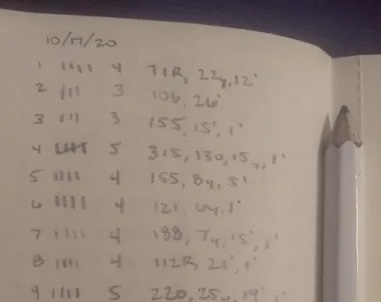
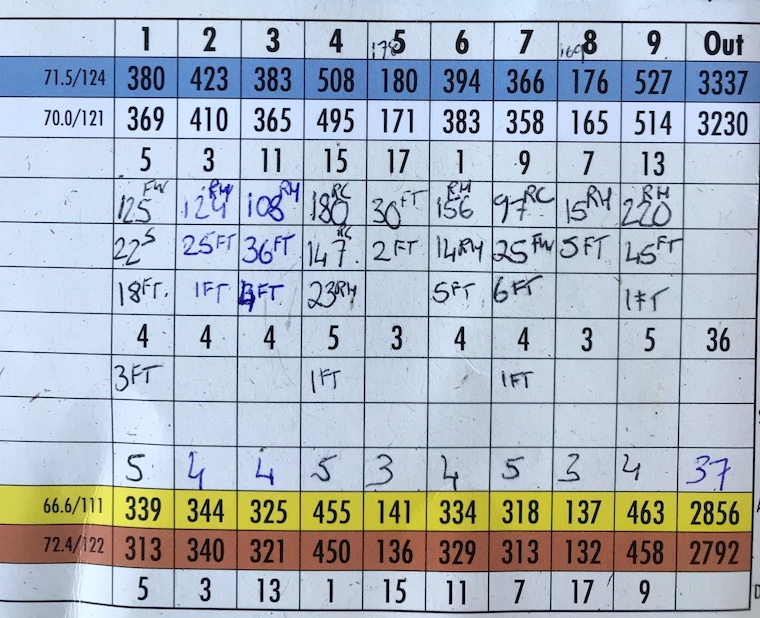
The usual pattern is optimistic. A drive that finished 232 yards out gets logged as “220 to the pin”, the approach becomes a 220-yard shot that you supposedly hit to 40 feet, and your approach numbers look better than the swing that produced them. Using Mark Broadie’s baselines, a 10-yard error on an approach is worth roughly 0.05 strokes. That sounds trivial until you multiply it by twelve approach shots a round in the same direction, every round.
Estimate to the nearest 5 yards and accept that a few will be wrong. The point of good data entry is not perfect precision on any single shot. It is avoiding a bias that repeats.
Getting the lie wrong
Lie is the field most often filled in from memory, and it carries more weight than golfers expect. From 150 yards, the expected score from the fairway is about 2.98 strokes. From the rough at the same distance it is about 3.22.
Mislabel one rough lie as fairway and you have thrown away a quarter of a stroke of credit for that shot. Do it consistently and two things break at once: your driving accuracy looks better than it is, and your approach play looks worse, because you are being judged against the easier baseline. Golfers in this situation usually conclude they need iron lessons when the real problem is off the tee.
Guessing putt distances
Putting is where sloppy entry does the most quiet damage, because the expected-strokes curve is steep and short.
A 10-foot putt takes about 1.6 strokes on average. A 25-footer takes about 1.9. If you log every putt outside gimme range as “15 feet”, you flatten that curve and your putting numbers drift toward zero from both ends. The 30-foot bomb you holed stops counting as the stroke and a half you gained, and the 8-footer you missed stops counting as the loss it was.
Pace them off. Three normal steps is about 8 feet, and that level of precision is enough. This matters more than any other single field if you want to know whether your putting is actually good.
Mishandling penalties and drops
Penalty shots are recorded wrong more often than any other shot type, usually in one of two ways. Some golfers log the penalty stroke but not the drop position, so the next shot appears to come from wherever the ball went in. Others skip the penalty entirely and just write a higher number on the card.
Both wreck the hole. A penalty is worth 1.4 to 1.8 strokes in most situations, and it needs to land in the right category to be useful. How strokes gained handles penalties and recovery shots covers the mechanics, but the short version is that the drop position is a real shot location and needs to be entered as one.
Abandoning a round halfway through
Partial rounds are a common casualty of a bad front nine. The problem is that an unfinished round is not neutral data, it is skewed data, and it skews in a predictable direction: people quit tracking after the holes that went badly.
Finish the entry even if you stop keeping score. If you genuinely walked in after nine, mark it as nine holes rather than leaving a partial eighteen in your history.
Comparing against the wrong benchmark
Not strictly an entry mistake, but it produces the same result: numbers you cannot act on. A 16-handicapper comparing to the PGA Tour baseline will show a negative strokes gained figure in all four categories, which is technically correct and completely useless. Everything is red, so nothing stands out.
Pick a benchmark near your own level and the relative differences become readable. Comparing to a 10-handicap rather than a pro is usually the more informative choice for a mid-handicapper.
Fixing golf tracking mistakes without slowing your round
Most of these errors come from entering data after the fact, in the clubhouse, from memory. Memory for shot distances decays fast, and it decays in a flattering direction.
Four habits cover almost all of it:
- Enter each hole before you leave the green. Thirty seconds while your playing partner putts out. Accuracy from memory drops sharply after two or three holes.
- Get the lie and the putt distance right, and estimate the rest. These two fields carry the most weight per keystroke.
- Set your clubs up once, properly. Inconsistent club naming splits your per-club stats into fragments that never accumulate enough shots to mean anything. If pace of play is tight, skipping club selection is better than entering it wrong.
- Log every round, including the ugly ones. You need roughly ten to fifteen rounds before category-level numbers stabilize, and a filtered sample never gets there.
Clean data will not lower your handicap by itself. What it does is stop you from working on your putting for six weeks when the strokes were leaking off the tee the whole time.
If you are just getting into it, how to track a new round walks through the entry flow in golfity step by step.