
Scoring by Par Type: What Your Par 3, 4 and 5 Numbers Reveal
Your scorecard total tells you how the round went. Splitting it into par 3s, par 4s and par 5s tells you why, and the answer surprises most golfers who assume the short holes are the problem.

Ask a golfer where they lost strokes and they will name a hole. The double on 14, the three-putt on 7, the tee shot that found the water. Scoring by par type asks a better question: across every round you have played, which kind of hole is quietly costing you the most?
The answer is rarely the one golfers guess. Most assume par 3s are their weakness because a bad one feels so exposed, or that par 5s are their friend because there is room to recover. Split the data properly and the opposite tends to be true.
What scoring by par type actually looks like
A par 72 course usually holds four par 3s, ten par 4s and four par 5s. Here is how average scores on each break down at different levels:
| Hole type | PGA Tour | 10 handicap | 15 handicap | 20 handicap |
|---|---|---|---|---|
| Par 3 | 3.06 | 3.50 | 3.70 | 3.90 |
| Par 4 | 4.03 | 4.45 | 4.60 | 4.85 |
| Par 5 | 4.66 | 5.40 | 5.60 | 5.85 |
Read down the columns and every amateur row looks worse than par on all three hole types. That is expected. The useful information is in the gaps, not the raw numbers.
For the 15 handicap, the gap to tour average is 0.64 strokes per par 3, 0.57 per par 4, and 0.94 per par 5. The hole type with the widest gap is the one most golfers describe as their birdie chance.
One honest caveat about the table: these figures represent a solid round rather than a typical one. A handicap index comes from your best 8 of your last 20 scores, so if you play to a 15, your everyday score sits three or four shots above the 83 these averages add up to.
Par 5 scoring is where amateurs give away the most
Multiply those gaps by the number of holes and par 5 scoring stops looking harmless:
| Hole type | Holes per round | Gap per hole | Strokes lost vs tour |
|---|---|---|---|
| Par 3 | 4 | 0.64 | 2.6 |
| Par 4 | 10 | 0.57 | 5.7 |
| Par 5 | 4 | 0.94 | 3.8 |
Par 4s take the largest total simply because there are ten of them. But per hole, par 5s are the biggest leak in the round, and it is not close.
The reason is structural. Tour players average 4.66 on par 5s and make birdie or better on roughly 44 percent of them. A 15 handicap makes birdie on a par 5 maybe once every three or four rounds, and makes a 7 or worse far more often than that. The extra shot that is supposed to be a cushion turns into a third opportunity to hit a bad one.
Watch what actually happens on a par 5 for a mid-handicapper. The tee shot goes 220 and leaves 280 in. The layup gets hit thin, or gets hit fine but stops at an awkward 65 yards. Then comes a half wedge from a distance nobody practices, a green missed, and a chip and two putts for 6. Nothing catastrophic happened, and the hole still played a full stroke over par.
The fix is almost never more distance. It is deciding your third-shot yardage before you hit your second, which is the core of the smart way to play par 5s. Laying up to a full sand wedge number you own beats scraping 30 yards closer to a distance you have to finesse.
Par 3s punish a single swing
Par 3s show a wide gap for a different reason. There is no recovery shot built into the hole. You get one long approach, and if you miss the green you are chipping to save bogey rather than putting for birdie.
The distance is what makes them hard. A regulation par 3 runs 170 to 190 yards, so the hole hands you a long iron or hybrid, the club most amateurs strike least reliably. A 15 handicap hits par 3 greens something like 20 to 30 percent of the time, compared to 65 percent on tour. We covered the mechanics of this in why par 3s are harder than they look.
What par-type data adds is proportion. Par 3s cost the 15 handicap 2.6 strokes a round against tour scoring, less than par 5s do, on holes that feel much more punishing. Par 3s hurt your mood. Par 5s hurt your card.
Par 4s decide the round by volume
Ten of your eighteen holes are par 4s, so this hole type sets the tone whether or not it is your weakness. A gap of 0.57 per hole is the smallest of the three, and it still adds up to 5.7 strokes, nearly half of everything a 15 handicap gives away.
That volume cuts both ways. Trimming a tenth of a stroke off your par 4 average takes a full shot off your score, which is why driving and mid-iron approach work pays back more than it feels like it should. It also means a par 4 problem is easy to miss, because it never shows up as a disaster hole. It shows up as a card full of bogeys that look reasonable one at a time.
Reading the shape of your own numbers
Pull your par-type averages from your last 10 to 15 rounds and compare the shape to the benchmark row for your level. Four patterns come up repeatedly:
- Par 5s are your worst relative hole type. Almost always a layup and wedge problem, not a power problem. Check where your third shots are being played from.
- Par 3s stand out. Your long irons and hybrids are the issue, or you are consistently short. Amateurs come up short on par 3s far more often than long because they club for their best strike.
- Par 4s are the outlier. Look at tee shots. Poor position on ten holes compounds faster than anything else on the course.
- All three are evenly bad. The problem is not hole-specific. It is putting, short game, or general contact, none of which care what number is printed on the card.
The last pattern is the one worth knowing about, because it means the answer is not in this breakdown at all. It is in your strokes gained by category, where putting and around-the-green results get separated out properly.
Turning the pattern into a plan
Par-type scoring is a diagnostic, not a practice plan on its own. Once you know which hole type is leaking, the next step is finding out which shot inside it is responsible.
Track your par 5s for three rounds and write down the yardage of every third shot. If most of them fall between 40 and 80 yards, you have found a specific, fixable gap in your wedge game. If your par 3 scores are dragged down by a handful of others, look for where the doubles come from rather than trying to make more pars.
In golfity, your scoring breaks down by hole type automatically as you log rounds, so the comparison takes seconds instead of a spreadsheet.
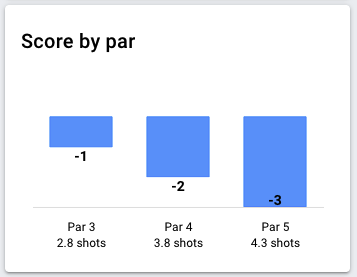
That example comes from a single Rory McIlroy round, which is why every bar sits under par. Yours will not look like that, and it does not need to. The question is only which bar sits furthest from the benchmark for your level.
Pair it with the strokes gained calculator to price out individual shots and see what a 65-yard wedge is really costing you against a full one.
Most golfers are one hole type away from a meaningfully better score, and it is usually the one they think they play well.